

A weekly schedule for building a high-impact design team
Three meetings and the trust that has to come before any of it

I want to open source my knowledge, but after much worry about the structure and table of contents, I decided to say fuck it be zen and start with something smaller.
This is a weekly schedule for a design team. It’s worked really well, if I do say so myself, as I’ve coached and managed high-impact, remote teams across Canva.
Before I get into the schedule itself, I must call out what must be true for this to actually work. I know how tempting it is to read a tips-and-tricks article, then run to implement it only for it to fail.
Jonesish is a reader-supported publication. If you enjoy what you’ve read and want to support me, please like and share, or subscribe to get further updates. Thank you!
First: trust. Trust is EVERYTHING. Trust in you as a leader, trust of your team in you, trust your team has in each other. Nothing works without this and sadly, there is no easy trick for this - no matter how many HBR articles and top 100 business books you read. As a leader, your number one goal is building every angle of trust in your team so people want to work together. It does not matter what schedule or framework or “hack” you add; if trust ain’t there, nothing is going to work. I’ve seen teams with airtight processes and documentation still fail because there wasn’t a warm, collaborative culture. This schedule only works when people are allowed to fail, to be a little silly, and to show their true selves. I really can’t stress this part enough.
Second: communication. You need an active, informal, async, private channel - Slack, Teams, Meet, whatever you use - for your team. It cannot just be for sharing work. People need to share funny things, random observations, and life updates. It builds connection, especially in a remote team, and serves as a good reminder that we’re people first. We will have highs, lows, good work, bad work, frustrations, and plenty of randomness along the way.
And, of course, your results may vary. One person’s perfect recipe isn’t necessarily the recipe for anyone else. See what works and what doesn’t within your own team, and adjust from there.
The schedule
The schedule consists of two mandatory sessions and one optional. You want your team's calendar protected for focus - not get filled up with endless check-ins. Everything else lives in that active Slack (or equivalent) channel.
Design Jam
Your weekly staff meeting, typically an hour, set early in the week.
There are three parts: announcements from me (things people needed to know), everyone’s highs, lows, and priorities for the week, and critique. You can run this informally, just talking things through live, or structure it with a doc.
This is where your team can talk through what’s going on in their world. Or get quick feedback for anything they’ll be working through that week. You can layer in structures, but I’d say don’t. You really just want to create a space for people to talk things through and see each other.
After doing this across many teams, I’ve learned that structure, like a doc, is great early on. It gives people something concrete to fill out. But over time, given how much async communication we’re all already doing, people tend to get tired of the doc format and just want time to yap. Dropping the doc in favor of live conversation also opens up more organic discussion, though there are tradeoffs. Quieter team members might have less space to share, but you also get more psychological safety without a running, permanent record of everything. Pros and cons - see what actually works for your team.
Critique
Your weekly critique session, typically an hour, set later in the week.
This needs much more structure than design jam. People need to sign up ahead of time, say what they want critiqued, and go through their scheduled blocks (typically 2-3 for an hour.) Anyone can still bring something unplanned, but the intent is that people are working toward this session across the week.
This is how your team builds a consistent muscle for giving each other feedback and maintaining the quality bar in your team. Designers, researchers, content designers, everyone should bring something to critique. You, as the leader, should be also bring your own work to be critiqued here. Leaders often skip this because they’re seen as the final approver, but in a fast-paced environment, having your own work critiqued - and showing your team you’re in it with them - builds trust in the decisions you make. 🗣️Again, trust is important 🗣️
A few practical notes:
Have a way to record feedback so it can be cross-referenced later.
Watch the size of the session. As your team grows, you still want groups small enough that it’s not overwhelming for the person asking for feedback.
Make room for both async critique (chat, written notes, etc.) and live, spoken critique - this accounts for everyone’s feedback style.
Have a strong moderator, usually a craft lead or senior designer, who can help frame feedback into key themes. (The person receiving critique can do some of this themselves, but the moderator keeps the discussion moving.)
(Optional) Craft Leads
Your fortnightly leads meeting, typically 45 mins, set at the end of the week.
This one is highly dependent on your team size. But it can help to have your design managers and specialty leads - research lead, content lead, and so on - meet on their own to discuss themes they’re noticing across the team.
This is where you catch things like people not sharing in design jam, or someone dominating the critique conversation, and figure out how to address it. It’s also a space to align on strategy - what the team needs to adjust, anticipate, or start working on.
At its core, this meeting is about your most senior designers and leads figuring out how to multiply the impact of the whole team. If you don’t have designated craft leads, look at who your next tier of senior or key designers are.
One caution: if everyone on your team is roughly the same level with no clear senior designers, don’t just pull a couple of random people into this room. That creates the guise of favoritism and undermines trust. Instead, look for people with specialised skill sets who are positioned to uplift the craft of your team AND are willing to take on that responsibility.
What this looks like in practice
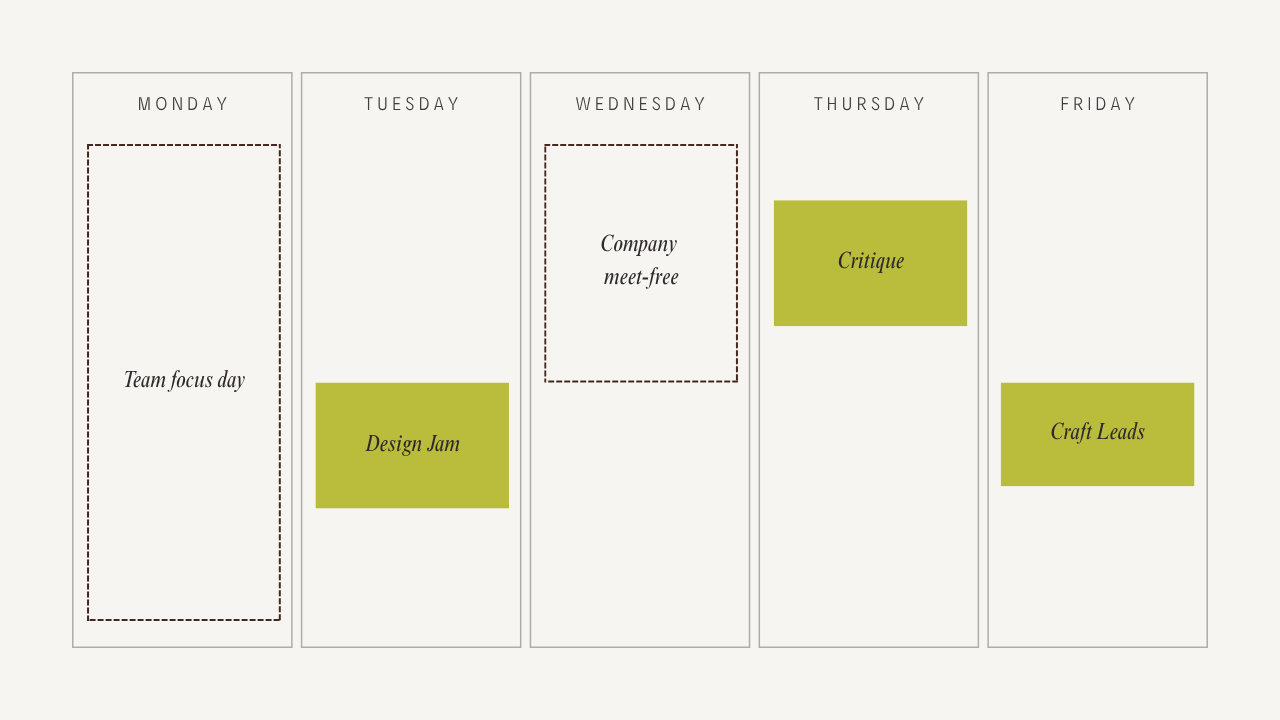
Tuesdays have Design Jam in the afternoon.
Thursdays have Critique in the late morning.
Fridays have Craft Leads in the late afternoon to sign off the week.
All other time should be for deep work, pairing with engineers and PMs, or aligning with other teams.
I'd love to know if you run something similar, or if you trial this with your own team - let me know how it goes!
And since I’m open sourcing, what would you like to hear more of? Happy to write more based on whatever questions come up.